
Farmerville Court Docket Searches
Farmerville publishes no public docket screen and no online ticket-search form. So the search starts with whatever court paper you have. Read the header. Does it name Farmerville Mayor's Court, the Union Parish Sheriff, Louisiana State Police, a Justice of the Peace, or Third Judicial District Court? That answer sets your path. Then call the town at (318) 368-9242. Ask staff to confirm the mayor's-court record by citation or ordinance number. One warning: a district-court search, a Sheriff payment page, and a town contact page are not interchangeable Farmerville docket systems. Each serves a different court.
- Read the document header and record the citation, ordinance, or case number.
- Call Farmerville and ask whether the item belongs to Farmerville Mayor's Court.
- Request the current Farmerville court date, the record-copy route, and payment or contest instructions.
- If the document names a Sheriff, State Police, JP, or Third JDC venue, contact that issuer instead.
- For a public copy, ask whether Farmerville can provide a plain record or a certified copy and how to submit a written request.
Farmerville Mayor's Court at the Parish Seat
Farmerville is Union Parish's seat and its largest incorporated town. The 2020 Census incorporated-place table counts 3,366 residents. That courthouse-hub status breeds confusion. Farmerville also runs a mayor's court of its own. Louisiana R.S. 33:441 and 33:442 supply the municipal ordinance jurisdiction and the mayor's-court docket framework. Keep the two courts straight. The Mayor's Court is not a division of the Third Judicial District Court. Town ordinance and local traffic matters can stay municipal. District criminal, civil, probate, and family cases belong to the Third JDC instead. Farmerville's officials page names the officials behind the mayor's court. It lists the town's municipal contacts too.
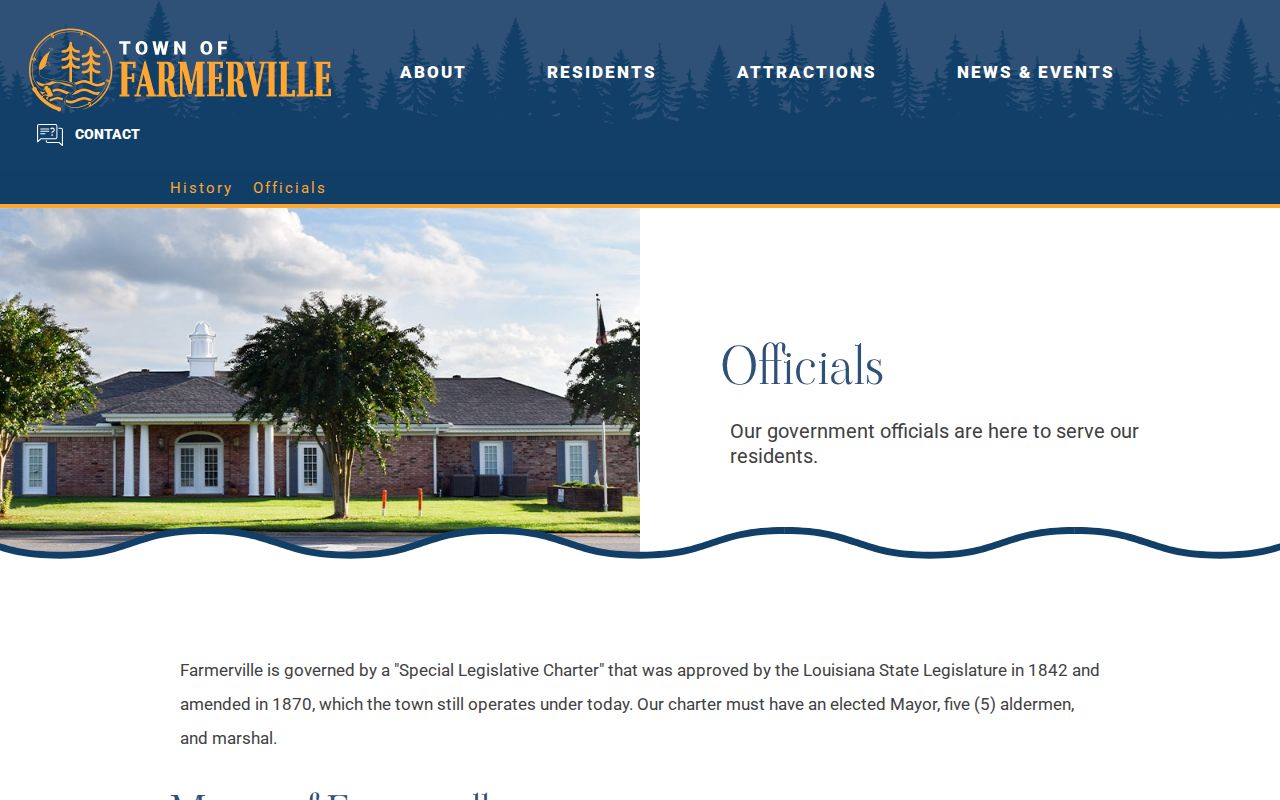
Farmerville officials: that page can point a local court question to the right town office without treating city staff as the Union Clerk.
Inside the Farmerville Municipal Court
The town's local court goes by its proper name: Mayor's Court. It handles town ordinances and local traffic matters. Its record and docket duties are set by state law. Farmerville's official pages name the municipal officials. They also list town clerk details, the city attorney or mayor's-court magistrate role, and marshal or police context. What they do not publish is a docket calendar, a caseload total, or a session schedule. No remote-hearing policy or live results system appears either. For anything record-specific, call the town first.
An entry in this court should show the local citation or ordinance. It should also show the setting and court action. The town has never published an official field inventory. Ask which document you are getting. Is it a docket, minutes, a payment status, a plain copy, or a certified copy? The distinction matters. A receipt alone is not the complete Farmerville court record.
Farmerville Court Office Addresses
Farmerville's own sources give more than one municipal address. The Louisiana Municipal Association profile lists Mayor Court at 407 South Main and P.O. Box 427. The Farmerville contact page instead gives 1024 Sterlington Highway, Farmerville, LA 71241. Both list the same number, (318) 368-9242. The two sources may describe different functions at different offices. Before you drive anywhere or mail a request, call the current town contact. Confirm where that service sits. Treat the mismatch as a routing question. It is not proof that every Farmerville court service runs at both spots. The current Farmerville contact page offers the town's official contact route.

Call before you go. The contact route is the right place to confirm which office holds a municipal docket or takes a written request.
Finding Farmerville Court Dates
Confirm a Farmerville municipal date with the town itself. Sitting beside the parish court offices proves nothing. Begin with the date printed on the citation or notice. Then ask the Farmerville contact whether that date still stands. Ask where to appear, what the setting covers, and whether a later notice changed it. A wrinkle appears if the case belongs to Third JDC. The Union court calendar may show a traffic block or other schedule. The case-specific setting is a different matter. It must be confirmed with the Third JDC or the Clerk. A municipal court date and a district-court calendar are separate records, full stop.
| Farmerville citation or ordinance number | Use the exact number on the notice; no official town format was located. |
|---|---|
| Farmerville court date | Confirm with the town or the court named on the document. |
| Setting location | Ask the town because official sources list different municipal addresses. |
| Case type | Identify an ordinance or local traffic matter before treating it as Mayor's Court. |
| Changed setting | Request the latest Farmerville notice or docket information from the custodian. |
Farmerville Court Roles and Records
Farmerville's officials page earns its keep. It separates roles that blur together as one court office. The town clerk, the municipal police or marshal context, the city attorney, and the mayor's-court magistrate each hold different paper. When you call, state your purpose plainly. Are you confirming a Farmerville Mayor's Court date, tracking down an ordinance or citation number, requesting a plain or certified record, or checking a payment or contest instruction? A clear request gets routed to the person who manages that Farmerville court record.
With no public docket screen available, naming the record type beats a vague records inquiry every time. The town can also tell you one more thing. Is a written municipal request required for a copy?
Farmerville Traffic Ticket Lookups
Do not mail Farmerville citation money to the Sheriff. The Union Sheriff Civil Office states plainly that it takes no Farmerville ticket payments. Farmerville posts no online ticket form, payment link, or docket results table either. So pick up the phone instead. Ask which town office holds the ticket. Ask whether any online option exists now. Ask how to verify the court date. If the citation itself names a different issuer, that issuer owns the record. That same issuer owns the payment route.
Sheriff, State Police, and Third JDC traffic matters work differently. For those, see the countywide Union Parish traffic court information. It covers the Sheriff route and the towns the Sheriff does not serve. It also explains the gap between paying a fine and reading the court file.
Farmerville Payment and Docket Differences
Paying a fine and pulling a court docket are two separate errands in Farmerville. A payment instruction from the town tells you where the money goes and nothing more. It is not a certified disposition. It does not hand you the full docket. The office keeping the Farmerville Mayor's Court docket may need its own written request. A copy could take that extra step. First confirm the town owns the citation; then ask about the current payment method. Farmerville publishes no official fine amount, payment deadline, contest deadline, deferred-disposition option, or defensive-driving program.
How Farmerville Cases Reach the County
Not every Farmerville case travels the same road. An ordinance or local traffic case can stay right in Farmerville Mayor's Court. The law moves it elsewhere only in limited situations. A Third Judicial District Court case lives with the Union Parish Clerk of Court. That holds even when the incident happened in town. Justice of the Peace papers sit with the ward office. So a Farmerville address tells you where something happened, nothing more. Treat it as location information, not as proof of who owns the court record.
Docket flow: Farmerville Mayor's Court › Union Parish Courts › Third Judicial District Court of Louisiana
Need a district-court case number or filing history? Use the Union Parish docket search routes once you know the case is not a Farmerville municipal matter.
Farmerville Court History and Access
Settlers arrived in 1839. A legislative charter incorporated Farmerville in 1842, per the town's own account. That parish-seat story explains why both town and district-court offices sit within practical reach in Farmerville. It does not merge their dockets, though. Treat the history as civic background. Do not treat it as a guide to any court's current schedule or record system. For live court access, lean on the citation. Lean on the town contact and whichever office owns the specific matter. Farmerville's official history gives the parish-seat and incorporation background itself.

That history explains why so many court offices cluster in Farmerville while their records stay separate.
Who Can See Farmerville Court Records
Louisiana public-record law governs Farmerville Mayor's Court records, with carved-out exceptions for protected material. R.S. 44:31 and R.S. 44:32 set the inspection and copying rules. A good Farmerville municipal request names the citation or ordinance, adds the date or case number if you have it, states the copy you want, and includes a way to reach you. Call before mailing anything. The town publishes no records-request form, copy fee, fax process, email process, or public terminal. Juvenile, sealed, and expunged files may simply be off limits through ordinary access.
Farmerville access rules: R.S. 44:31 recognizes public-record inspection and copying subject to exceptions. R.S. 44:32 addresses a custodian's regular-hours presentation and permitted copy costs. R.S. 33:441 supplies the mayor's-court municipal jurisdiction framework.
Farmerville Court Record Request Checks
Check a few things before any Farmerville request goes out the door. Confirm the current office address and who actually keeps the record. Confirm the record type, too. Ask whether the matter really belongs to the Union Clerk, the Sheriff, State Police, or a Justice of the Peace instead. Ask about plain versus certified copies, the fee and payment method, and the current court setting when that matters. Farmerville offers no public terminal, online citation search, posted copy price, or automatic mail workflow. A question tied to a citation or ordinance number helps. It gives town staff the best shot at routing you correctly.
Farmerville Municipal Officials and Records
The town's officials page names Mayor John Crow. It also lists marshal and police chief Ernest “Bim” Coulberston, the town-clerk contact, and city attorney or Mayor's Court magistrate Joe Cusimano. These names help you describe your question on a call. They do not prove each person keeps the same paper. Ask directly for whoever handles the Mayor's Court docket. Ask for the citation date, the ordinance record, or your copy request.
The official contact page lists 1024 Sterlington Highway, Farmerville, LA 71241. The same page gives (318) 368-9242 and info@farmerville.org. The Louisiana Municipal Association profile separately lists Mayor Court at 407 South Main and P.O. Box 427. Two sources, two addresses, and different municipal functions behind each. Always call before you visit or mail a Farmerville court-record request. That address split may be the most practical detail in your whole search.
Farmerville Court Request Checklist
Write the request so it reaches the right desk the first time. Name the specific court in Farmerville rather than the town alone. Give the citation or ordinance number, the date, and the party or caption if you know them. State plainly what you want. A docket entry, minutes, a plain copy, or a certified record all work. Before mailing anything, ask where to send the request. Ask which payment the office takes. Ask whether the town truly holds the file or another office does. If the paperwork points to Third JDC, the Sheriff, Louisiana State Police, or a Justice of the Peace, reroute the request. Do that before any money changes hands.
Farmerville's public sources make no promises. No online citation search, no single copy fee, no fixed turnaround time. A current contact page and a direct call beat an old vendor link every time. They also beat assuming the parish-seat town keeps everything in house. Once a reply arrives, keep it with the citation. That way a later request can be tied back to the same municipal record without starting over.