
Union Parish Criminal Docket Searches
Felony and Code of Criminal Procedure charges in Union Parish land in the Third Judicial District Court, and the Union Parish Clerk of Court Criminal Department keeps the criminal docket once the district attorney files. The Clerk's own site is the place to begin. An online criminal-records route is offered there. Match what you pull to the defendant, filing date, charge, parish, and case identifier. Treat any search result as a locator, nothing more. It may lack filed documents or the latest hearing status.
One caution on vendors. The Clerk's online-services page currently routes criminal records through COTT E-Search “for now” and describes a move to eClerks. Open the live Clerk link and confirm the destination. A hearing that just happened may lag too, since minutes sit under verification before release. Criminal staff post motions and orders, while minute clerks release the verified minutes to the public.
- Open the Clerk’s current criminal-records link and confirm that it is the criminal route.
- Search the defendant’s name, then narrow the result with Union Parish and a reasonable filing-date range.
- Compare the case identifier, date filed, and charge before opening or requesting a record.
- Use the Clerk for a public minute, full docket information, or a certified copy, and use the court office to confirm a live setting.
Note: A charge is an allegation, not a conviction or other final disposition.
Union Parish Criminal Search Filters
The eClerks Criminal Search covers criminal matters statewide, which makes it a useful lead rather than a stand-in for the Union Parish docket. Its filters shine when a surname is common. Enter a last name first. Add the first name when known. Apply a From Date and To Date. Then select Union Parish. Wildcard behavior, refresh timing, and complete historic coverage go undocumented on the tool, so an empty result should never end your venue check.
| Search field | Type | Required | Use in a Union search |
|---|---|---|---|
| Last Name | Text | Practical starting field | Begin with the defendant’s surname. |
| First Name | Text | Not stated | Use it to separate like surnames. |
| From Date / To Date | Date fields | Not stated | Use a bounded period to reduce results. |
| Parish | Checkbox or facet | Not stated | Limit the statewide result set to Union Parish. |
The Clerk's online-records routing page splits its services into criminal, civil, land, and marriage paths. Starting there beats assuming an old vendor label still works.
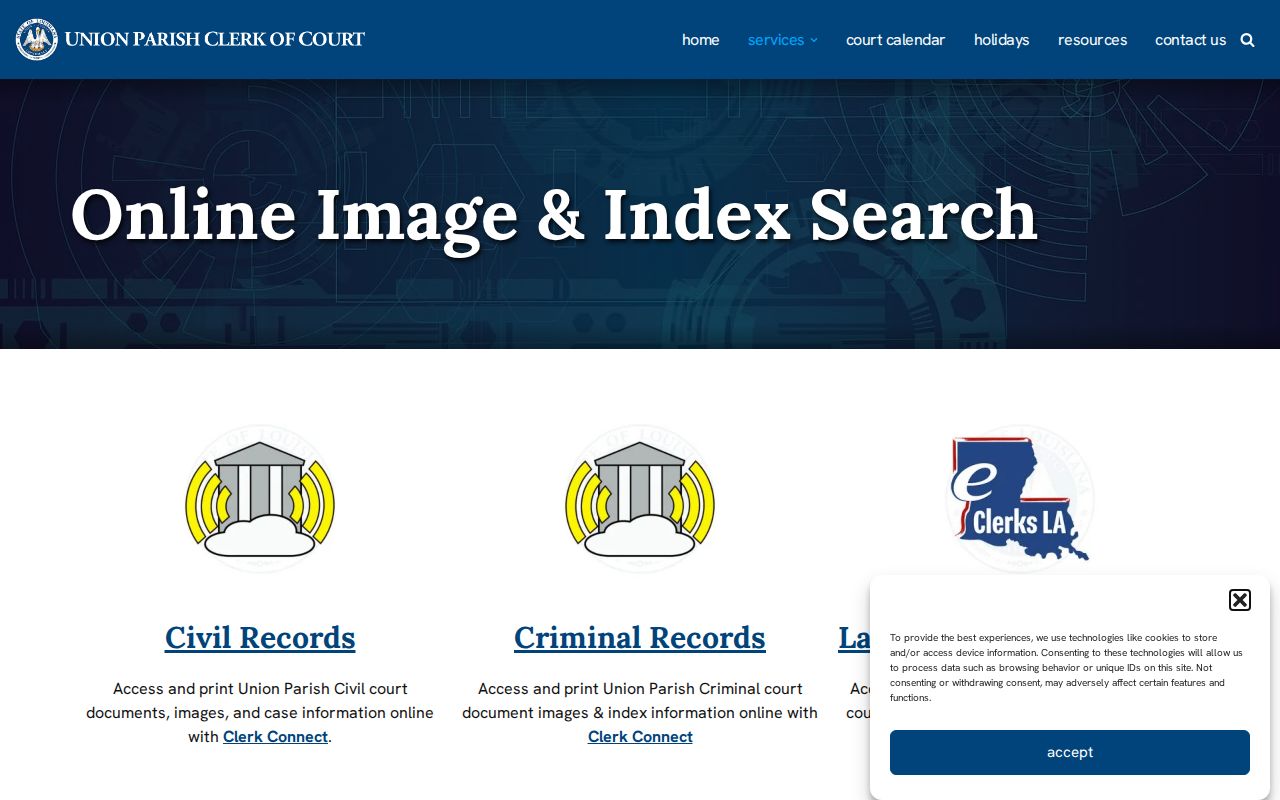
That split matters. A land or marriage index is no stand-in for a Union Parish criminal docket search.
Criminal Dockets: What They Show
A criminal docket is a timeline, not a story. In the documented eClerks criminal result view, the list can show Defendant, Birth Date, Sex, Race, Case, Date Filed, Charges, Arrest Date, Parish, and Alert. Click into a case for more. The detail view can carry the case identifier, filing date, defendant, charges, parish, and a Date and Minute Details history. Documents, bond, counsel, and any final disposition may or may not surface. Confirm those on the live Union view itself.
| Case identifier | The criminal case reference shown by the result. No official Union case-number format was published. |
|---|---|
| Date filed | The filing date helps distinguish results with similar names. |
| Charges | Allegations listed in the result, not a finding of guilt. |
| Parish | The location field used to confirm that the result belongs in Union Parish. |
| Minute details | Chronological minute information when the result opens a case-detail view. |
Check the newest dated event first. An older setting can mislead, and a minute summary never equals the full set of exhibits, transcripts, or certified court documents.
Verified Union Parish Criminal Minutes
Minutes explain the lag you may see online. Criminal minute clerks, as the Clerk describes them, transcribe the court outline. They release minutes only after verification. Processing deputy clerks get matters ready for hearings. They also post motions and orders to the computer system. So a hearing held this week can be missing from a public minute or index view for a time. That gap does not mean the case went away.
For anything current, ask the Clerk directly whether a public minute, docket copy, document image, or certified copy exists. The minute-clerk line is (318) 368-8026. The main Clerk number is (318) 368-3055. Office hours run weekdays, 8:30 a.m. to 4:30 p.m. Before visiting, confirm where the department sits. Official Clerk pages show both a main office and temporary department routing.
For local filing and hearing-form rules, the Third Judicial District Court rules page is the official stop. What it cannot do is turn a calendar block into a case-specific criminal outcome.
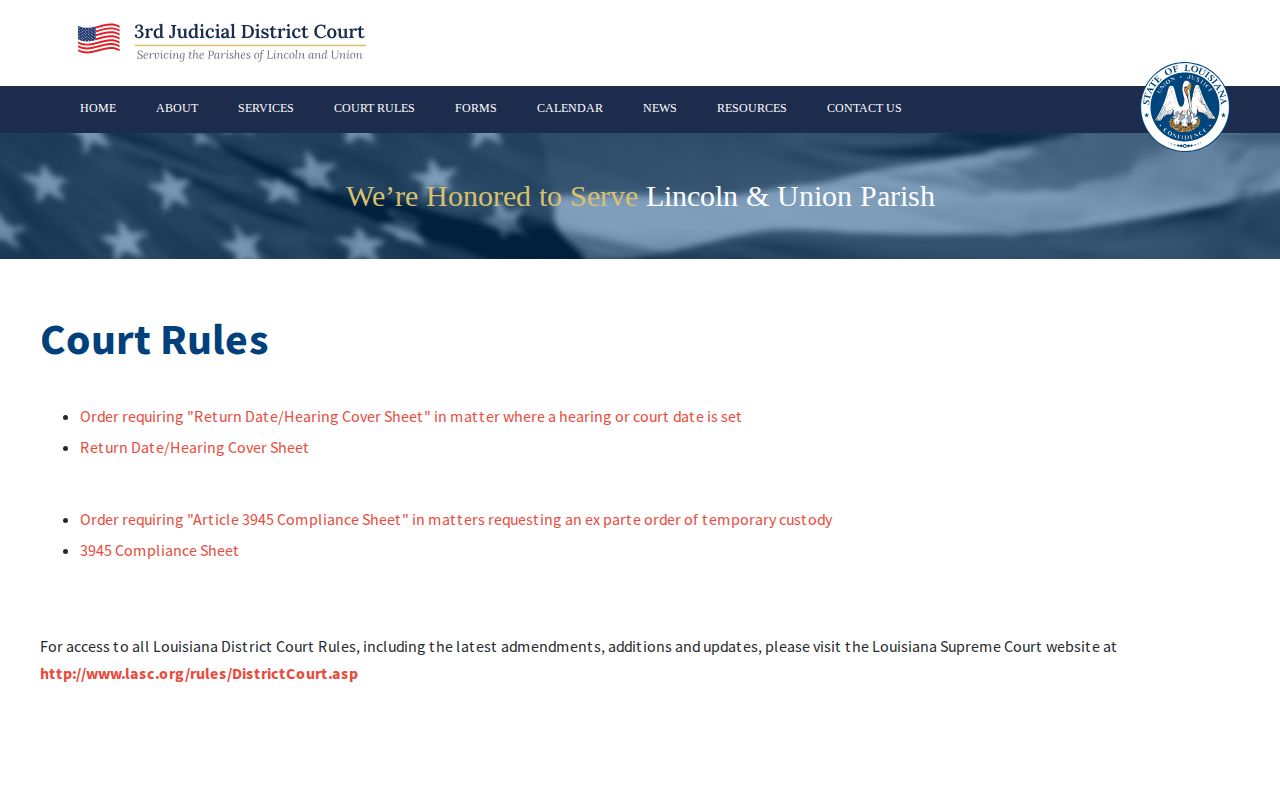
Use the live docket or minute history for the answer. That is how you connect a local rule, filing, or setting to the correct case.
Criminal Case Stages on the Docket
Criminal docket activity often follows a sequence, but each case can take a different path. The usual reading order is: Filing → Arraignment → Pretrial → Plea or Trial → Disposition → Sentencing. Each arrow represents a possible stage or series of entries, not a promise that every matter will have the same number of dates.
- Formal charges
- The criminal filing language used by the Clerk for charges received from the district attorney.
- Pretrial
- A court setting before trial; it is not a trial or a disposition by itself.
- Minute
- The verified court-outline record released by the Clerk when public access applies.
- Disposition
- The actual court result shown in the docket. Use the local label, rather than assuming an abbreviation means the same thing everywhere.
A trial setting, plea activity, or sentencing reference needs the case record before you treat it as settled. The published calendar spots court blocks. It says nothing about the charge, the result, or whether a particular person must appear.
Union Parish Criminal Pretrials and Juries
The 2026 Union schedule marks criminal court days, criminal pretrials, jury-trial blocks, and regular court. Those labels give a court date its context. A pretrial block is not a trial promise. A jury block reaches some cases, not all. Always chase the newest case entry, notice, or order before trusting a calendar item as the live setting.
Call the Union Parish Judges’ Office at (318) 368-9734 with a scheduling question. The Clerk still owns docket and minute access. When an event has just occurred, call. Do not read a missing online update as a result.
Union Parish Criminal Docket Courts
Union Parish keeps its criminal docket with the Clerk of Court. That clerk serves the Third Judicial District Court of Louisiana. The court covers both Union and Lincoln Parishes. So Union felony matters and Code of Criminal Procedure charges belong on its docket. The court runs three divisions across the district. The published Union calendar splits events into blocks by division.
Some matters never touch district court at all. A mayor's court can run its own ordinance or traffic docket. A Justice of the Peace office keeps separate limited records. A sheriff's or state trooper's citation may stay with the agency that wrote it. When a docket search comes up empty, read the citation or notice first. It may name a different court, and that check beats assuming no case exists.
Union Parish Criminal Results Need Venue Check
A statewide criminal hit is only a lead. It cannot prove the Third Judicial District Court owns every Union Parish matter. So match the parish and charge against the paper notice before you go further. Then sort out the venue. Is it district court, a mayor's court, a Justice of the Peace court, or traffic tied to the agency that issued the ticket? Appeals add one more layer. The Court of Appeal, Second Circuit hears appeals from Union's district court, and its appellate docket stands apart from the trial docket.
This check matters most for traffic, juvenile, expunged, sealed, and municipal cases. eClerks Criminal Search cannot replace those separate routes. A written request works best when it names the court, any known case number, and the date range wanted. Say whether you seek a plain copy, a certified copy, or a minute copy.
Access Rules for Criminal Dockets
Louisiana law backs public inspection. Yet it does not make every criminal docket free or openly searchable. Under Code of Civil Procedure article 251, the Clerk is the legal custodian. The public may examine or copy records during office hours unless another law limits access. Two public records statutes, R.S. 44:31 and R.S. 44:32, cover inspection, copying, and presenting requests during regular hours.
Public access has limits. R.S. 13:5992 provides electronic criminal minute-entry or summary access for qualifying matters filed on or after January 1, 2020 through the LCRAA framework. It does not cover traffic, and it has stated exceptions. Juvenile, sealed, expunged, and protected records are not normal public-search material.
Ask the custodian what you need and what it costs. The Clerk of Court sets copy fees and fulfillment options, and no single certified-copy price covers every Union Parish criminal docket request. Call ahead for the current rate and the accepted mail, fax, or email procedure.
Union Parish Criminal Record Limits
A restricted record is not a failed search. Louisiana law limits access to juvenile matters. An expunged adult case stays confidential except where a statute grants access. A blank result or missing image can also mean vendor indexing lag or the wrong court. Never try to work around an access control. The Clerk or court can explain the lawful procedure tied to the record.
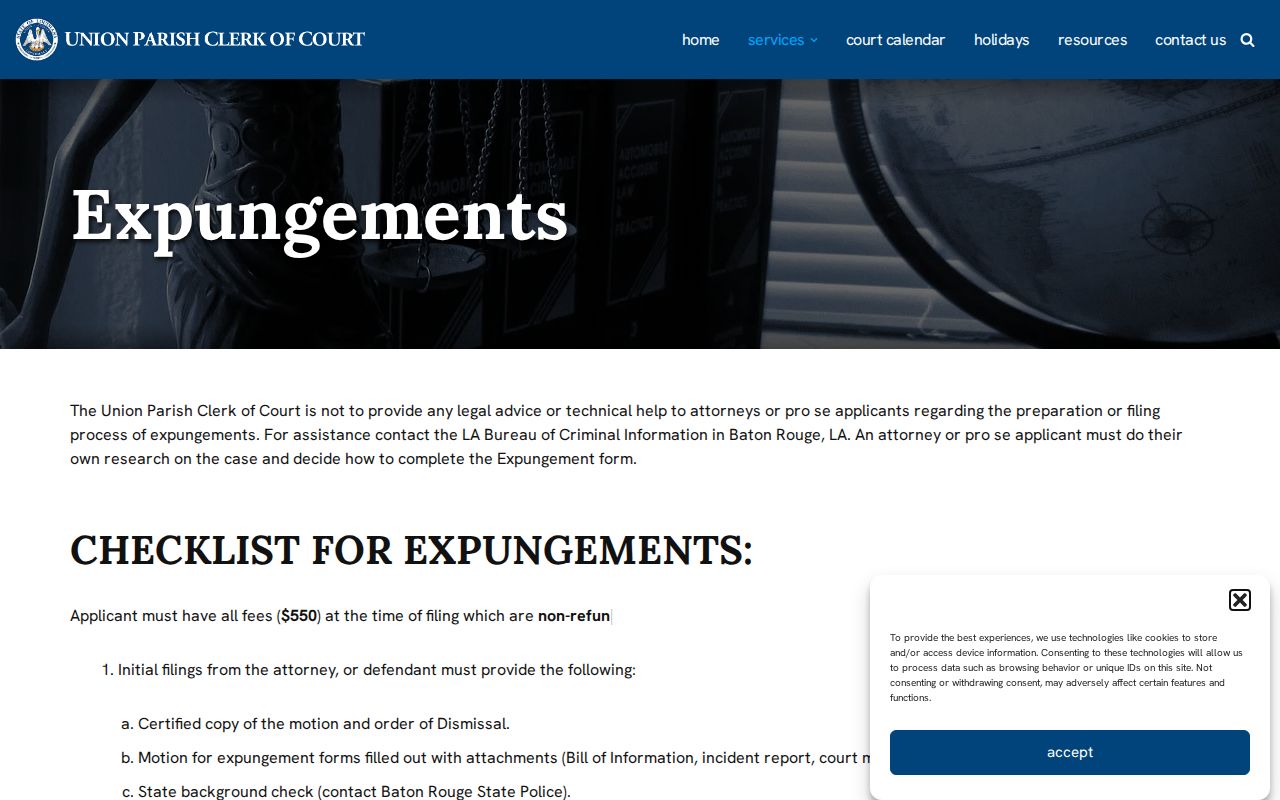
The Clerk's expungement information shows a local checklist plus agency materials. That process clears a record. It is not a way to obtain expunged case information.
For public criminal docket work, trust the accessible result, the verified minutes, and the access decision the custodian makes today.